
Key Takeaways
- Remember, hot air rises and sun exposure make attic rooms warmer, so control heat flow first to keep a converted attic comfortable and efficient.
- Combine active and passive cooling, like attic fans, whole house fans, ductless mini-splits, ceiling fans, and night-time ventilation, to drop peak temperatures fast.
- Optimize your building envelope with radiant barriers, enhanced insulation using dense-pack cellulose or spray foam, and air-sealing to reduce heat infiltration and cooling expenses.
- Maximize ventilation with balanced ridge, soffit, and gable vents along with smart attic fans or operable skylights to exhaust hot air and intake cooler air when possible.
- Lower solar gain with reflective window films, heavy drapes, exterior shade, and light-colored roofs reduces indoor temperature and protects your furniture.
- Think long-term by installing efficient cooling equipment, conducting routine maintenance, keeping tabs on your attic climate, and abiding by building code and safety regulations.
How to cool a converted attic room in a Davis home is a guide to pragmatic, locally appropriate cooling solutions for small, sun-exposed spaces. It includes lessons on insulation, ventilation, shading, and right-sized cooling systems tailored to the Davis climate and home types. Specifically, these simple upgrades include reflective roof barriers, attic fans, window films, and ductless mini-splits. The main body provides detailed options, step-by-step choices, estimated costs, and energy-saving tips for each alternative.
Thermal Dynamics
Attics naturally collect heat, as hot air rises and accumulates in the area around your roof. In a converted attic room, this can make the ceiling and upper walls much warmer than the lower floors of the house. The heat that accumulates aloft, generated from internal gains, solar loading through the roof, and warm air leakage, can significantly impact your air conditioning system. This pooled heat increases the average temperature in the living space, forcing cooling systems to work harder during hot summer days.
How hot air rises and accumulates in attic spaces
Warm air is lighter than cool air, so it floats upward and occupies the uppermost portions of the building. In a poorly ventilated and poorly insulated attic, that hot blanket can be several degrees hotter than the lower rooms, making it essential to consider passive ventilation options. When residents turn on lights, electronics, or a heat-producing HVAC duct or appliance, those sources contribute to the attic’s heat load. Practical steps include adding or upgrading insulation at the roof and kneewalls, as well as installing a whole house fan to promote air circulation and reduce heat buildup.
Impact of sun exposure on roofs and walls
The sun’s rays heat roof sheathing and rafters, which conduct heat into interior surfaces, particularly affecting the whole house system. Dark roofing materials can increase surface temperatures by as much as 50 to 90 degrees compared to reflective alternatives. To combat this, consider installing a radiant barrier underneath the roof deck or opting for high-reflectance shingles to decrease heat transfer. Additionally, implementing ventilation systems, such as ridge vents and soffit vents, allows solar heat to escape before it bleeds inside, improving indoor air quality and comfort during the hot summer months.
The stack effect and its role in attic heat flow
The stack effect accounts for air leaking ‘up’ in the house because warm air rises and escapes through upper-level leaks, sucking cold air in at lower levels. During the summer, this can draw hot outdoor air in through basement or ground-level openings, negatively affecting indoor air quality by feeding the attic load. To control the stack effect effectively, it is essential to air seal the upper levels and implement balanced ventilation systems. Continuous attic sealing at ceiling plates and controlled intake vents will help minimize uncontrolled inward flow.
Why understanding heat flow matters for cooling solutions
Understanding where heat originates and its movement allows you to select the appropriate fixes for your whole house. Proper insulation and air sealing significantly reduce conduction and infiltration. Incorporating ventilation systems and radiant barriers can effectively address solar and stacked heat, while shading and reflectance help minimize incoming energy. When you pair passive ventilation options with an active cooling system, such as a ductless minisplit designed to circulate cool air throughout the living space, the attic stays comfortable with less energy consumption.
Proven Cooling Solutions
Transformed attic rooms heat up fast from roof exposure and restricted ventilation, especially during the hot summer months. To cool down these spaces, consider installing a whole house fan, which can effectively enhance passive ventilation by drawing in cool air through open windows at night. Gain proven cooling solutions that focus on heat gain reduction, ventilation, and localized cooling to maintain comfort with smaller equipment.
- Active cooling includes ductless mini-splits, portable air conditioners, whole-house fans, attic fans, window ACs, and ceiling fans.
- Passive cooling includes radiant barriers, increased attic insulation, reflective roof materials, window films, cross-ventilation, and shading.
- Hybrid tactics include timed ventilation, such as opening windows at night and running a whole-house fan. Combine a radiant barrier with an attic fan. Use a mini-split with a ceiling fan for lower setpoints.
1. Ductless Systems
Ductless mini-splits provide conditioned air straight to the attic room, effectively cooling down the space during hot summer days while eliminating losses from extensive duct runs. These systems mount on an inside wall with a slim refrigerant line leading to an outdoor condenser, ensuring minimal changes to your home’s structure. With zoned control, you can cool only the attic room when you open the windows at night, and separate indoor units allow for different set points in bedrooms, living areas, and the attic. Efficiency typically surpasses that of older central systems since inverter compressors can modulate speed and minimize short cycling, making them a great option for enhancing indoor air quality. Installation is fairly rapid, with a trained technician usually finishing a single head within hours.
2. Radiant Barriers
A radiant barrier beneath the roof decking reflects radiant heat back toward the roof instead of allowing it to enter the attic space. This helps reduce peak attic temperatures on sunny days and heat flow into the finished living space below. When combined with proper insulation levels, radiant barriers are most effective in minimizing heat gain. Homeowners can experience less runtime on their cooling system and modest utility bill savings when barriers are implemented alongside passive ventilation options.
3. Smart Ventilation
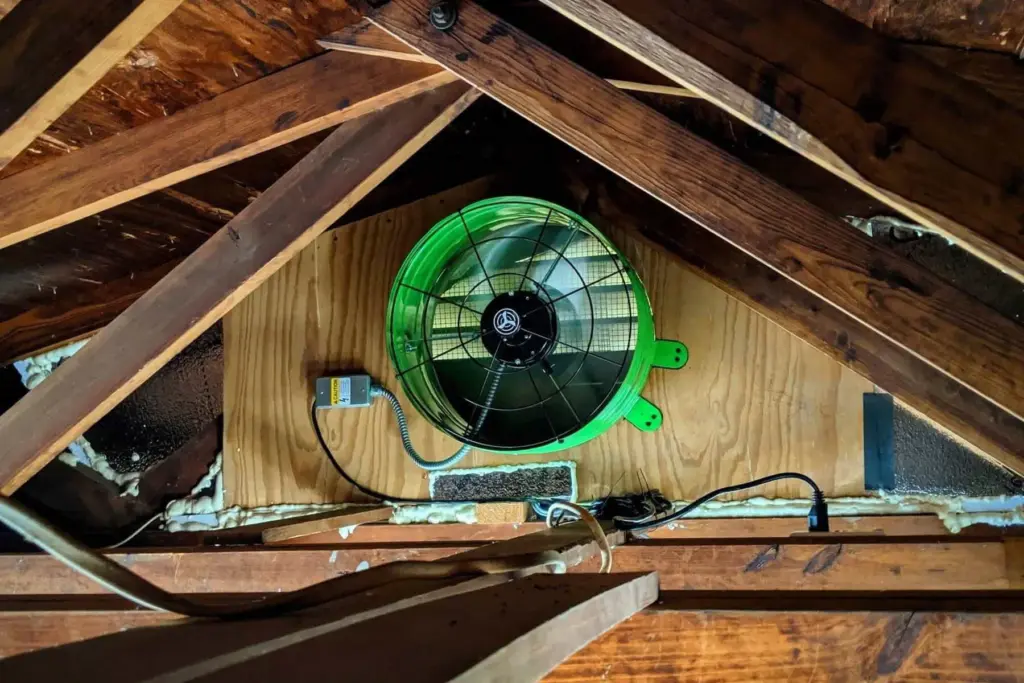
Automated attic venting, a crucial aspect of improving indoor air quality, deploys thermostats, humidity sensors, and variable-speed fans to expel hot air efficiently. By pairing ridge and soffit vents for a stack effect, and adding gable vents where cross-flow helps, you can enhance your whole house ventilation system. Thermostatically controlled attic fans operate only when temperature levels reach a certain point, preventing needless energy consumption and ensuring a comfortable living space during the hot summer months.
4. Window Films
Reflective window films can significantly reduce solar heat in your living space by rejecting shortwave radiation at the glass. For optimal results, treat south- and west-facing attic windows with high-SHGC reducing films and pair them with heavy curtains or blackout drapes. This layered shading approach not only diminishes interior temperature fluctuations but also protects furnishings from UV fade, enhancing indoor air quality.
5. Air Sealing
Seal any gaps around windows, access hatches, plumbing chases, and recessed lighting with caulk, weatherstripping, or spray foam. Stopping uncontrolled infiltration keeps cooled air in and hot air out, lightening the load on any cooling system. Correct sealing likewise reduces moisture penetration and protects against pest infestations. Have a professional conduct a blower-door or infrared inspection to identify leaks and prioritize repairs for your whole house.
Insulation Upgrades
Good insulation is essential for staying cool in a converted attic room in a Davis home, especially during the hot summer months. Proper insulation minimizes heat transfer and eases the burden on your air conditioning system by eliminating drafts. Attention should be given to both the attic floor and the roof deck, as the floor limits heat rising into the living space, while the roof deck prevents radiant heat from entering through the roof. Insulation upgrades not only save on utility bills but also stabilize indoor temperatures for years.
- Fiberglass batts are low cost and easy to install. Their R-value is moderate. Gaps are common if not cut well. They are best for standard joist spacing.
- Cellulose (loose-fill/dense-pack) offers good gap fill, has higher recycled content, resists airflow when dense-packed, and moisture control varies by installation.
- Spray foam (open-cell/closed-cell) provides the highest air seal and has a high R-value per thickness. It is more costly and acts as a vapor retarder if closed-cell.
- Mineral wool is fire resistant, provides good sound control, has a higher cost, and resists moisture and mold.
- Reflective foil and radiant barriers reduce radiant heat from roof surfaces. They are effective in hot climates with ventilated attics and need an air gap to work.
Dense-Pack Cellulose
| Feature | Dense-Pack Cellulose | Fiberglass Batts | Spray Foam (Closed-cell) |
|---|---|---|---|
| R-value per 25 mm | ~0.95 | ~0.64 | ~1.06 |
| Air leakage control | Good | Poor | Excellent | | Best for uneven cavities | Yes | No | Yes | Cost | Moderate | Low | High | | Recycled content | High | Low | Low |
Dense-pack cellulose is blown into the cavities at a high density, which pushes it into small voids and around obstructions. That tight fill lessens convective loops and drafts that fuel heat gain in summer. In older homes with uneven framing or cut joists, dense-pack fills in where batts leave holes. Cellulose is primarily recycled paper treated for fire resistance, providing a low embodied-carbon alternative. It can buffer the moisture, helping moderate indoor humidity levels, but adequate ventilation and vapor barrier placement are still critical if you don’t want to trap wetness in certain climates.
Dense-pack is a good solution for attics with odd spaces and truss webs. Installers can get through tiny access holes. Anticipate less noise pollution as a bonus. For retrofits, air seal major leaks first around chimneys, recessed lights, and top plates. Then install dense-pack for both air resistance and thermal improvement.
Spray Foam
Spray foam can create an air and moisture barrier in one application, a handy trait when roof sheathing or framing is complicated and ducts snake through the attic. Closed-cell foam supplies the most R-value per inch and provides structural stiffening. Open-cell provides excellent fill and cost savings, but requires vapor control in certain climates. Foam seals air leaks that bring heated air into the space and minimizes condensation danger on warm surfaces.
Apply spray foam in areas of limited access or irregular cavities where batt installation is difficult. It reduces mold risk by maintaining drier surfaces and reducing routes for moist air. They are more expensive, but energy savings and comfort tend to pay for them over time in well-sealed conversions.
Airflow Management
Airflow management for a converted attic room starts with knowing how air flows through the room and where it stalls. Attics tend to trap hot air near the roof and stagnate with blocked vents or a layout that stops cross flow. Tackling these problems in turn requires both strategizing permanent alterations, including a whole house fan, vents, fans, and insulation, and everyday practices such as furniture placement and window opening schedules. Here’s a straightforward checklist and actionable steps to keep air flowing, with examples tailored to tiny guest rooms or spacious master suites, especially during the hot summer months.
Checklist for optimizing attic airflow
- Check and clean soffit, ridge, and gable vents. Clean out debris and insulation clogging openings.
- Check attic insulation and make sure it’s not covering intake vents. Install baffles where necessary.
- Introduce or balance attic and room vents. Make sure each vent is adequately sized for room volume.
- Install or upgrade attic and room fans: intake, exhaust, and ceiling fans where appropriate.
- Test airflow paths with a smoke pencil or incense stick to find dead zones.
- Rearrange furniture and storage to keep vents and return air paths unblocked.
- Schedule biannual maintenance: clean vents, check fan bearings, and inspect ductwork.
- Keep an eye on indoor temperature and humidity and adjust accordingly with a small digital sensor.
Arranging furniture and storage to promote circulation
To improve indoor air quality, keep beds and heavy dressers away from outside walls with vents or air returns, especially during the hot summer months. Ensure there is at least 30 to 45 centimeters of unobstructed space in front of floor or wall vents, allowing air to flow freely into the living space. For sloped ceilings, avoid placing wardrobes under eaves where return air could pool, as this can hinder the effectiveness of your whole house fan. Utilize low-profile bins or open shelving to facilitate air circulation around objects, ensuring a comfortable environment.
Ceiling fans to enhance cool air distribution
To effectively cool down your living space during the hot summer months, consider installing a ceiling fan sized appropriately for the room: 91–122 cm blades for small attics and 122–152 cm for larger rooms. Set the fan to rotate counterclockwise to blow cold air down, creating a refreshing breeze. Ensure the fan is positioned at least 2.1 m above the floor and centrally located for optimal air dispersion. Incorporating variable speed and timer-enabled fans with smart controls can enhance your cooling system, especially during peak heat or when the house is unoccupied, while pairing with a whole house fan can usher hot air out effectively.
Regular attic maintenance to keep vents clear
To maintain proper airflow in your whole house fan, check vents and fans bi-annually and after storms. Clear the intake of nests, leaves, and dust, and ensure that your ventilation systems are functioning effectively. Regularly change or clean fan filters, lubricate motor components, and inspect all duct joints for any gaps to maintain optimal airflow and prevent degradation.
Microclimate Optimization
With microclimate optimization, the goal is to transform the local conditions surrounding and inside a converted attic to minimize heat gain and make the living space comfortable without intense mechanical cooling. Begin by addressing the exterior and roof vents, then implement elements that allow hot air to escape and improve indoor air quality. Each change alters the way heat transits your attic, and little, appropriately placed efforts frequently provide big comfort returns.
Exterior shade: trees, awnings, exterior blinds
Planting shade trees on the sun-facing side significantly minimizes direct solar load on the roof and walls while enhancing outdoor air quality. Opt for deciduous trees that provide shade during the hot summer months and allow sunlight in the winter. Ensure that the trees are planted at least 3 to 5 meters from the house to prevent root or foundation issues, while still shading the roofline. Additionally, installing stationary awnings over dormer windows or south-facing walls can effectively reduce heat gain. Using aluminum or acrylic fabrics with a UV rating is ideal. Outside blinds or roller screens attached to the roof edge or window frames can prevent heat before it reaches the glass or siding, optimizing your cooling system. For tenants or cramped sites, consider fastened removable shade sails overhead to minimize peak afternoon sun exposure.
Operable skylights for venting
Operable vented skylights are an excellent option for improving indoor air quality by allowing hot air to rise and escape the attic, especially during the hot summer months. By mounting them at or near the ridge, you can maximize the stack effect. To enhance this passive ventilation system, combine a low intake, such as a soffit vent or controllable window, with a high operable skylight for continuous airflow. Consider adding a whole house fan to further cool down your living space. Ensure to seal well around the flashing and use insulated curbs to prevent leaks and thermal bridging.
Dehumidification and indoor moisture control
Attic conversions can lead to increased moisture from living spaces and roof leaks, raising the perceived temperature and promoting mold growth. To combat this, deploy a small, portable dehumidifier calibrated to the room volume, targeting a relative humidity of 40 to 50 percent. For a standard 20 to 30 square meter attic room with poor insulation, a 10 to 20 liter per day unit is practical. Additionally, consider installing a whole house fan to improve ventilation and air circulation. Ensure to air seal around light fixtures, ducts, and plumbing stacks to prevent humid air infiltration.
Light-colored roofing and reflective finishes
White or reflective roofs significantly reduce solar intake, making them ideal for maintaining a comfortable indoor air quality. Opting for high SRI materials such as cool metal or reflective shingles can reduce peak roof surface temperature by 40 to 80 degrees Celsius. If you’re considering a system retrofit, using reflective roof coatings for your roof type is both inexpensive and quick to apply. Pairing these with a whole house fan and ventilated roof assemblies, including ridge vents and soffits, helps to effectively cool down the living space by shaking heat loose before it can conduct inward.
Long-Term Efficiency
Long-term efficiency in a converted attic room hinges on three interconnected areas: the equipment you choose, how well the space is sealed and insulated, and how you maintain the whole house fan system. Emphasizing efficiency not only minimizes operating expenses and keeps your living space comfortable as seasons change but also reduces the risk of moisture issues and structural complications that can arise over time.
Invest in energy-efficient systems and insulation
To effectively cool down your attic during the hot summer months, it’s essential to select cooling equipment sized to the attic’s real load. Mini-split heat pumps with high seasonal energy efficiency ratios (SEER) often work best for attics, providing spot cooling without duct losses. For a Davis home, opt for units with inverter-driven compressors and a SEER of 16 to 20, striking a balance between upfront cost and long-term savings. Pair a right-sized unit with improved insulation, ensuring you add at least R-30 to R-49 in the attic floor or cavity, depending on local climate. If the attic becomes a conditioned living space, utilize continuous insulation on the roofline. Closed-cell spray foam not only insulates but also air-seals those hard-to-reach gaps, while fiberglass or cellulose is a less expensive option that requires meticulous air-sealing around any penetrations to maintain R-value. Additionally, installing a whole house fan can enhance passive ventilation, helping to reduce heat gain and improve indoor air quality during heat waves.
Regular inspection and maintenance
Schedule a semi-annual inspection of your whole house fan system. Inspect vents, flashings, soffits, and ridge vents for blockages, animal nests, or damage. Evaluate insulation depth and check for compression, gaps, or moisture staining, which are signs of air leaks or roof problems. Clean or replace filters in mini-splits and central air conditioning systems every 1 to 3 months. Have a professional come out once a year to verify refrigerant charge, fans, and drain lines. Seal attic access with insulated doors or hatches to avoid conditioned air loss. Record every inspection so you can identify patterns and intervene before minor problems become costly.
Monitor temperature and humidity trends
Attach a small data logger or smart thermostat that logs hourly temperature and relative humidity to improve indoor air quality. Follow these over weeks to locate peak hours and problem days, then use that information to alter setpoints, add dehumidification, or modulate ventilation systems. If temperatures soar midafternoon, consider installing a whole house fan or increasing attic insulation to cool down your living space. If humidity remains elevated, inspect for duct or roof leaks and consider a properly sized dehumidifier to prevent mold growth. Use trend data to help justify upgrades and demonstrate if rebates or efficiency measures have their worth.
Comply with codes and safety
Observe local building codes for headroom, egress, stairs, insulation, and wiring, especially when considering ventilation options like a whole house fan. Employ licensed contractors for structural modifications, HVAC systems, and electrical runs to ensure proper installation of air conditioning units. Make sure smoke and carbon monoxide detectors are installed by code and that combustion appliances have proper venting.
Conclusion
Cool attic remains habitable with these easy steps. Seal around windows and eaves. Install 150 to 300 mm of loft insulation to reduce heat gain. Install reflective foil under the roof to decrease peak roof temperatures by several degrees. Position a ductless mini-split on an outside wall for rapid, zoned cooling. Ceiling and box fans circulate air and reduce the felt temperature. Screen south and west facing windows with blinds or outside awnings. Install roof vents and a ridge vent along with a solar attic fan if the roof angle is suitable. Follow local sun patterns and plant a petite shade tree or erect a pergola to intervene afternoon heat.
Select the combo that suits budget and floor plan. Begin with seal, insulation, and one active cooler. If prepared, add steps in vents, shade, and efficient systems. Have a local contractor measure load and size equipment. Want an easy checklist to get going? I can build one.
Frequently Asked Questions
How can I quickly lower temperature in a converted attic room?
Begin with shading and ventilation! Shut blinds or install reflective window film, and open the windows at night to cross-ventilate. Additionally, operate a whole house fan or portable fan to exhaust the hot attic air, providing rapid and inexpensive cooling.
Will adding insulation help cool my attic room?
Yes. Good insulation keeps the heat of the roof from leaking in and enhances comfort with less energy consumption. Focus on roof and knee wall insulation, as well as proper insulation, to maximize the effectiveness of your cooling system.
Is an attic ceiling fan or portable AC better?
A ceiling fan circulates air and enhances comfort cheaply, while a whole house fan can efficiently cool down the entire living space during hot summer days, making it a great ventilation option.
How effective is attic ventilation in reducing heat?
High ridge vents, soffit vents, or a whole house fan help keep heat out of the roof cavity, decreasing cooling load and enhancing comfort in your living space.
Can window treatments make a real difference?
Reflective blinds, blackout curtains, or exterior shades prevent solar heat gain, which helps cool down the living space by lowering cooling watts, especially on south- and west-facing windows.
Should I upgrade windows or add film for efficiency?
Make a longer-term investment by installing double-glazed low-e windows, which can enhance the indoor air quality and help cool down your living space during the hot summer months. Window film is less pricey yet reduces solar heat the same.
How do I balance humidity and cooling in an attic room?
Using a dehumidifier or an air conditioner with good moisture removal is essential for maintaining indoor air quality. Proper ventilation systems and sealing help keep humid outdoor air away, making your living space more comfortable.