
Key Takeaways
- Match the filter to the pollutant for best results: opt for HEPA for particulate matter like dust and pollen, and select activated carbon for gases, odors, and VOCs.
- Go with combined HEPA and carbon systems when you have both particulate and gas or odor problems to achieve complete indoor air purification.
- Look beyond marketing and check performance metrics and certifications like true HEPA ratings and carbon adsorption capacity to confirm real-life effectiveness.
- Oversight of airflow replacement intervals and room size can lead to diminished system efficiency and shorter filter life.
- Match filter selection to your lifestyle — pets, cooking, smoking — and use an air quality monitor to determine changes after making a switch.
A carbon air filter captures gases and odors while a HEPA filter catches microscopic particles such as dust and pollen.
Carbon filters utilize porous activated charcoal to absorb VOCs, smoke, and odors.
HEPA filters capture a minimum of 99.97 percent of particles 0.3 microns in size, eliminating allergens and fine dust.
Many air purifiers combine both to tackle particles and odors at the same time, providing a more comprehensive boost to indoor air quality.
Filtration Fundamentals
Air filters are filters that remove contaminants from the air indoors for health and safety reasons. They do this by either trapping solids or capturing gases and odors, and the one you need depends on which pollutants are present.
Particle filtration protects against dust, pollen, and particulate matter. Gas absorption targets odors, smoke, and VOCs. Most systems mix filter types to address both requirements.
HEPA Filters
HEPA filters are meant to trap a minimum of 99.97% of particles down to 0.3 microns, such as dust, pollen, spores and some fine combustion particles. The rating is based on a specific test particle size.
In actual usage, HEPA frequently filters out particles both larger and somewhat smaller than this with even higher efficiency. HEPA media is dense and pleated for surface area maximization.
Air flows between the fibers and particles are trapped through interception, impaction, and diffusion. This physical trapping means HEPA does not rely on chemicals and maintains performance until clogged.
HEPA is particularly useful for allergy and asthma sufferers, or rooms with high levels of particulate pollution, such as an apartment in the city near a busy road or a fine dust generating workshop.
For most homes, a MERV 8 or 11 prefilter in front of the HEPA can remove larger dust and extend HEPA life. However, HEPA filters do not remove odors, gases, or VOCs.
They won’t filter out cigarette smell, cooking vapors, or chemical fumes. For those contaminants, another strategy is required.
Carbon Filters
Carbon filters contain activated carbon, whose highly porous surface adsorbs gases, odors, and chemical fumes. Adsorption is a surface process.
Molecules stick to the carbon rather than pass through a dense media. Carbon filters take out smoke smell, pet stink, cooking odors, and many VOCs.
They’re in kitchens, smoking rooms, and anywhere with off-gassing paints or cleaners. How it performs depends on how much activated carbon it has, its quality, the contact time, and the chemical you’re targeting.
Carbon filters won’t grab dust or pollen or any other tiny little particles. They can collect some bigger dust, but they’re a lot less efficient than HEPA or high-MERV filters for particle capture.
All-in-one HEPA/carbon units can be a compromise. Built-in media is space-saving but doesn’t have the capacity of separate, dedicated stages.
Carbon filter longevity depends on use and pollutant load. A general rule is to replace every 60 to 90 days in active settings.
Systems that filter particles and gases are often needed to truly solve indoor air quality. The best results come from a good, specific match of filter type to pollutant.
MERV-rated prefilters are for particles, HEPA is for particles, and activated carbon is for gases.
Core Differences
HEPA and carbon filters perform similar but different functions. HEPA filters are designed for particles. Carbon filters are designed for adsorbing gases and odors. Knowing which indoor pollutants dominate a space guides the choice. Particles need high-MERV or HEPA media, while smells and VOCs need activated carbon.
1. Target Pollutants
HEPA filters trap dust, pollen, pet dander, mold spores, and fine particles. They can capture approximately 99.97% of 0.3µm particles, making them the standard option for allergy management. Common pleated filters rated MERV 8 to 13 are a sensible daily choice for dust and bigger allergens.
Carbon filters combat cigarette smoke, chemical fumes, VOCs, and just plain nasty odors. They adsorb gas molecules and are often used where odors or fumes are the predominant problem. Carbon can snag some larger dust, but it is much less effective than HEPA or high-MERV alternatives.
No filter type alone takes care of all impurities. For homes with both heavy dust and stubborn odors, coupling filters or combined media makes sense. Mixing the two media is a compromise and sometimes a deadening of the best qualities of either.
2. Filtration Mechanism
HEPA functions by pushing air through a tangled labyrinth of fibers. Particles are eliminated by interception, impaction, and diffusion. It is a mechanical interception process powered by fiber density and air flow.
Carbon filters utilize activated carbon granules or pads to physically adsorb gas molecules onto a high surface area. Adsorption is a chemical and physical surface process, not simple sieving. Material quality and bed depth matter. More carbon surface means better gas capture and adds resistance.
The two operate on different pollutant categories: particles with mass versus gas molecules without mass. One cannot replace the other as mechanisms and targets vary.
3. Ideal Environments
Use HEPA where particulate load is high: homes with pets, near construction, medical areas, cleanrooms, and allergy-prone households. HEPA is your friend for fine dust and biological spores.
Employ carbon in kitchens, smoking lounges, garages, or industrial environments with VOCs or chemical odors. It suits welding fume extractors and odor-prone spaces.
Often the best approach pairs them: HEPA for particles and carbon for gases where both risks exist.
4. Lifespan & Costs
HEPA filters usually last 6 to 12 months, depending on usage and particle load. Carbon filters become saturated with gases and generally require replacement every 1 to 2 months, although certain carbon inserts adhere to a 90-day cycle even in light usage scenarios.
The upfront cost of HEPA is higher and carbon has ongoing replacement costs. Combo filters can go bad faster if one part becomes saturated first.
5. Airflow Impact
Dense HEPA media impedes airflow and can disproportionately reduce HVAC efficiency if not properly sized. Bulk carbon further contributes resistance, particularly at greater adsorption capacity.
Verify purifier or HVAC compatibility prior to upgrading. Track airflow and pressure drop to maintain system performance.
Performance Metrics
Performance metrics measure what filters filter and how well they serve indoor air goals. Ozone generation for ozone machines. Match these metrics to your needs: particle-focused goals, such as allergen reduction and fine dust, prioritize particle-capture numbers and MERV/HEPA ratings.
Odor or VOC control requires adsorption data and carbon mass. Take a calibrated air quality monitor to measure PM2.5, PM10, VOCs, and odor proxies before and after filter use to see real-world effectiveness. Always check manufacturer specs for rated removal efficiency, tested flow rates, and recommended life.
HEPA Standards
HEPA means High Efficiency Particulate Air and a real HEPA has to eliminate 99.97% of particles at 0.3 microns. That 0.3 µm being the most penetrating particle size, performance is usually equal or better at both smaller and larger sizes.
True HEPA filters pass rigorous industry and regulatory test methods, not marketing claims, so seek out documented test reports or third-party confirmation. There are tiers: standard HEPA (99.97% at 0.3 µm), advanced HEPA (higher capture at broader size range), and ultraHEPA or medical-grade units (greater than 99.99% efficiency).
Watch out for HEPA-type or HEPA-like labels; these rarely meet the 99.97% standard. For typical home use, pairing HEPA with an MERV 8–13 prefilter removes larger dust while shielding the HEPA media. MERV 8 or 11 filters catch many common home particles and assist in diminishing visible dust and allergy triggers.
Carbon Metrics
Carbon filter performance is given in terms of adsorption capacity, typically grams of pollutant adsorbed per gram of carbon, and breakthrough time at specific concentrations. The most important physical factors are carbon mass, granule size, and surface area, with larger carbon bed depth and higher surface area providing better VOC and odor removal.
Thin carbon pads or light surface coatings might catch some larger dust but seldom offer significant gas control. Serious carbon sheets beat simple pads for stubborn smells or chemical fumes. Look for manufacturer test data on specific VOC removal rates and for established certifications where applicable.
Typical service life is shorter than HEPA. Carbon filters often need replacement about every three months, while HEPA filters last six to twelve months depending on load. Strong smells or heavy use require more frequent change. Use combined systems when both particles and gases matter. HEPA filters are for 0.3 µm particles, and carbon filters are for gases and smells.
Synergistic Filtration
Pairing HEPA and activated carbon filters provides a more comprehensive removal spectrum than either individually, attacking both particulates and volatile chemicals. This two-stage approach is ideal for most indoor needs where dust, allergens, smoke, and odors co-exist. It reduces load on each filter when properly positioned.
The Combined Approach
Sometimes air enters a purifier and smacks the HEPA stage first, capturing 0.3 µm particles with great efficiency. That initial pass strips away dust, pollen, mold spores, pet dander, and a lot of combustion particles. This protects those solids from gumming up the carbon bed and maintains consistent airflow.
Following the HEPA stage, the airflow passes through the activated carbon membrane where adsorption seizes gases, VOCs, and odors. Carbon operates by adhering molecules like formaldehyde, benzene, and smoke to its porous surface. A few include a pre-filter in front of HEPA to capture large particles, which provides additional protection to both HEPA and carbon media.
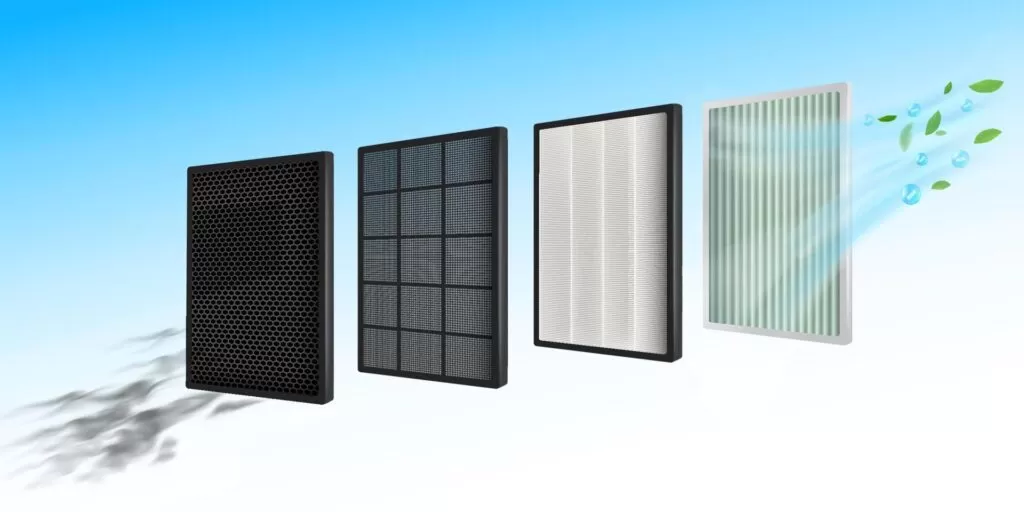
Some high-end units utilize distinct, dedicated carbon modules that can be sized or exchanged independently of the HEPA cartridge. That design allows manufacturers to maximize carbon volume and bed depth for increased gas removal. It also makes replacement schedules straightforward.
Correct sequencing — coarse pre-filter, HEPA, then carbon or pre-filter, HEPA, and dedicated carbon chamber — is important as it balances particle capture with gas contact time. It needs regular care. HEPA filters generally require replacement every 6 to 12 months based on usage, whereas activated carbon lifespan is more variable, commonly between 3 to 12 months. This variability depends on the pollutant load.
By cleaning pre-filters and monitoring pressure or airflow changes, you can extend service life and keep the system working near peak.
System Design
Synergistic Filtration: Purifier size and filter capacity should be matched to room volume and pollutant sources. A bedroom with cooking odors requires less carbon than a garage painting session. Calculate room volume in cubic meters and select units designed for a minimum of your room’s ACH goal.
Pick HEPA and carbon components rated for your needs: true HEPA (H13 or H14) for clinical-level particle removal; thicker carbon beds or higher surface-area carbon for VOC-heavy environments. It’s the sensors and auto modes that really add value, turning fans up or down based on particulate or VOC readings to save energy and extend filter life.
Checklist to evaluate air purifier features:
- Room coverage (m³) and ACH ratings
- True HEPA certification level (H13/H14)
- Carbon bed volume or grams of activated carbon
- Presence of pre-filter and washable components
- Sensor types (PM2.5, VOC) and auto mode
- Filter replacement cost and availability
- Noise levels at different fan speeds
- Energy use (watts) and smart controls
A Practical Viewpoint
HEPA and activated carbon filters solve different issues. HEPA traps particles such as dust, pollen, pet dander, and smoke’s fine solids. Activated carbon adsorbs gases and odors including volatile organic compounds (VOCs), cooking smells, and tobacco smell. As they act on different pollutant types, one seldom substitutes for the other. Frequently, both are required to clear the air.
Lifestyle Assessment
Pet owners have dander and hair that HEPA filters snare nicely. Smokers deal with two issues: visible particulates and a lingering odor. HEPA takes out the particulates, and carbon deals with the odor, so anticipate dual filters or a combo unit. Regular chefs produce grease mist and smell. A carbon stage reduces odors, and a HEPA stage reduces fine soot.
Allergy sufferers should put HEPA foremost. It consistently eliminates allergic pollen and dust mites that cause flare-ups. Use surface dust and stubborn odors as straightforward evidence that your filtration is not performing well enough. If dust returns in a matter of days, then your rate of particle filtration or circulation is probably low.
If odors persist after ventilating a room, the carbon load is likely too light or exhausted. Try utilizing an air quality monitor — PM2.5 for particle pollutants and VOC/eCO2 sensor for gases to detect the difference after exchanging filters or integrating a purifier. For mold issues, combine an air purifier with a dehumidifier to eliminate excess moisture. Taking spores out of the air is helpful, but mold can’t grow without damp air!
Marketing Versus Reality
While makers are quick to tout square footage or CADR (clean air delivery rate) in perfect scenarios, real rooms have furniture, open doors, and varying ceiling heights that degrade performance. Seek out third-party tests, AHAM or similar lab reports, and third-party reviews instead of marketing blurbs. Don’t anticipate a single filter variety to fix all. A HEPA-only unit won’t remove paint fumes and a carbon-only unit won’t stop pollen.
| Marketing claim | Typical reality |
|---|---|
| “Eliminates odors completely” | Reduces many odors; severe smells may persist unless carbon volume is large |
| “Covers X m²” | Often optimistic; placement and room layout change effective coverage |
| “One filter for all pollutants” | Rarely true; particles and gases need different media |
| “Clinically tested” | Check for third-party lab reports and test conditions |
While you can always add lots of activated carbon to make it more effective at odor removal, it’s not very practical to do that in a tiny, inexpensive unit. Combining HEPA and carbon in one device is a common compromise: it helps broadly but may underperform a dedicated, high-capacity single-purpose filter.
A few purifiers, one for particles and one for gases, or a strong all-in-one unit are both practical choices based on budget and room needs.
Lifecycle Considerations
Lifecycle considerations compare the environmental, operational, and cost impacts of carbon and HEPA filters as they proceed through their usable life, replacement rhythm, and end-of-life treatment. Both types require regular attention. Carbon filters generally last about 3 to 6 months depending on air quality, usage, and filter size. Many HEPA-style filters follow a similar replacement cadence.
Lifecycle considerations include impact on continued cost, waste, and footprint.
Disposal Challenges
HEPA and carbon filters can frequently contain trapped particles, biological components or adsorbed chemicals. Certain captured material can be dangerous, particularly if filters accumulate industrial emissions, dense smoke, or chemical fumes. Improper disposal risks releasing those pollutants back into the environment during handling or as they degrade in a landfill.
Adhere to local waste and hazardous-material regulations when disposing of used filters. Local regulations vary. In some cases, filters are accepted with regular trash. In others, they must be treated specially or dropped off.
Place used filters in robust plastic bags prior to transport or disposal to minimize dust escape and contamination to individuals and surfaces. For homes, stowing the old unit in its original carton or bundling it tightly facilitates secure carrying. For industrial workplaces, check with safety officers and waste contractors to avoid violations.
Recycling Efforts
Filter material recycling programs are beginning to surface. The majority of residential HEPA and carbon filters continue to be nonrecyclable due to contamination and composite materials. Commercial and industrial environments sometimes have take-back programs or centralized recycling streams which segregate metal frames, plastics, and spent media.
Backing brands that offer take-back or recycling programs helps amplify those solutions. Premium molecular air filters are engineered to reduce environmental impact by utilizing low-footprint materials, optimizing in-use efficiency to reduce energy consumption throughout their lifespan, and constructing for durability to minimize replacements.
One gram of activated carbon may have a surface area greater than 32,000 square feet, due to millions of microscopic pores that allow it to adsorb VOCs, smoke, and other gases. That high efficiency can extend functional life when appropriately matched to typical pollutant loads.
Molecular systems seek to eliminate VOCs, toxic gases, and odors and, when fine-tuned, minimize lifecycle emissions by reducing fan energy and replacement frequency. Think about washable or reusable filter alternatives where accessible to reduce waste and long-term expense.
Reusable pre-filters paired with replaceable HEPA or carbon stages can extend time between full replacements. Promote better recycling infrastructure and purchase products with explicit take-back policies to diminish environmental impact and regulatory liability.
Conclusion
Carbon filters absorb odors and gases. HEPA filters trap small particles such as dust, pollen, and smoke. Each filter serves an obvious purpose. Use carbon for odors and VOCs. Use HEPA for particles that hurt lungs. Most homes and offices combine both. A combo unit reduces both odors and particulates quickly. Think about room size, pollution source, and noise constraints. Monitor filter life and replace components on time. For allergies, opt for true HEPA with a sealed pathway. For cooking or paint fumes, opt for high-adsorbent carbon with a larger surface area. Little things, like keeping windows closed during periods of high pollution or running the fan on low, yield better results. Looking for a brief buying checklist or model recommendations for a particular room? I can assist.
Frequently Asked Questions
What is the main difference between a carbon air filter and a HEPA filter?
Carbon filters eliminate gases, odors, and VOCs through adsorption. HEPA filters mechanically trap minuscule particles such as dust, pollen, and the majority of airborne allergens. They address different pollutants.
Can a carbon filter remove viruses or bacteria?
No. Carbon filters won’t reliably remove viruses or bacteria. HEPA filters can catch a lot of airborne bacteria and virus-sized particles when combined with appropriate airflow and air changes per hour.
Should I choose a carbon or HEPA filter for allergy relief?
Go HEPA for allergies. HEPA filters eliminate pollen, dust mites, and pet dander, which are common allergens. Carbon helps if odors or chemical smells trigger symptoms, but it won’t block particulate allergens.
Do combined carbon+HEPA units work better than single filters?
Yes. Combined units provide more comprehensive protection. HEPA tackles particles, and carbon tackles gases and odors. Together, they tackle both the particulate and gaseous pollutants for cleaner indoor air.
How often should I replace carbon and HEPA filters?
HEPA filters should be replaced every 6 to 12 months, depending on usage. Carbon filters should be replaced every 3 to 6 months or when odors resurface. Consult the manufacturer’s directions and your room conditions for optimal timing.
Are carbon or HEPA filters energy efficient?
Filter type alone doesn’t dictate energy consumption. More resistant filters can boost fan power. Seek out air purifiers with energy-efficient motors and CADR ratings to get the best tradeoff between filtration and energy consumption.
Can a HEPA filter remove smoke and cooking odors?
HEPA catches the smoke particles but not the scent. For smells and gas-phase chemicals from smoke or cooking, a carbon filter is required. Consider a hybrid for visible smoke and odors.